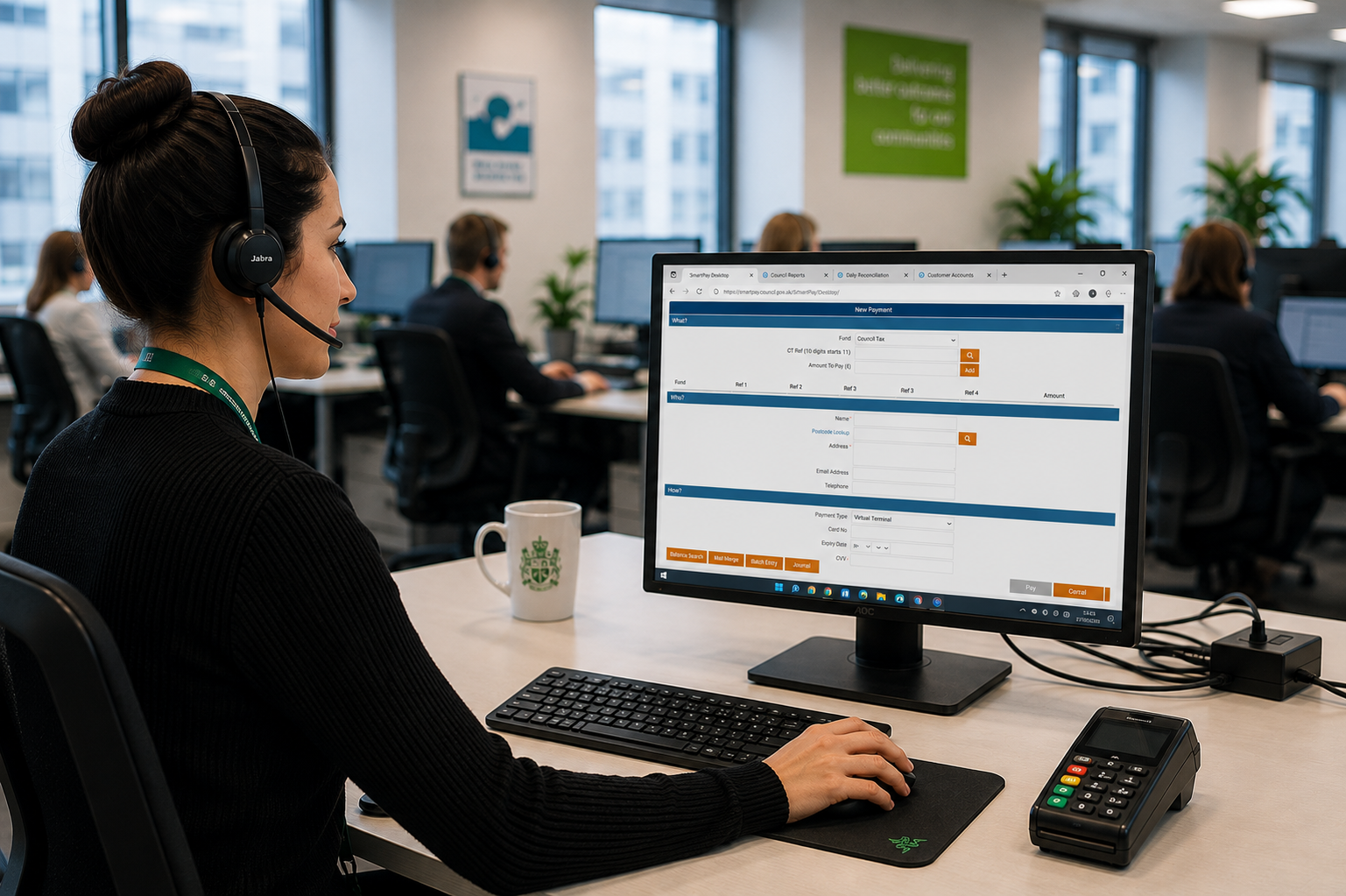
7 ways payment solutions can help local councils save time and deliver an exceptional customer experience

When it comes to taking payments, it’s easy to write it off as a purely transactional, functional task. But for local councils, an exceptional payment solution can create ripple effects across the business. Here’s how. 


By providing customers – and departments – with payments choice


We all expect to be able to pay for goods and services in whichever way we want, wherever we want. And when we can’t, we notice – and often feel negativity towards whichever organisation we want to pay or buy something from. 


By offering a wide range of payment options – from online and over the phone or on the go – you can ensure the act of making a payment is a simple one for your customers, rather than being a source of frustration. 


Internally, it’s important too. Offering a wide range of solutions ensures each department has methods of receiving payments that are suitable for their needs, and speeds things up, too. 


By being available around the clock


The days of only taking payments during traditional business hours are well and truly over. Today, organisations need to be able to transact around the clock – and that means having payment options that never sleep. 


And it’s important, too, because people make payments 24/7. So by making it easy for customers to make payments whenever they want, you’re reducing the load on staff when it comes to manual chasing and follow-up, and reduces the team effort required enabling payments to be made more efficiently. 


By enabling easy collation across distributed departments


Local councils have many different revenue streams, with different departments overseeing different sources of income. By ensuring your payments solution is capable of collating cross-division transactions, you can reconcile with ease, and have a real-time source of truth, all day, every day. 


By providing real-time reporting


From car park revenue to council tax, councils have a whole host of income streams to manage. By choosing a payments solution with real-time reporting, you have up-to-the-minute information from which to build reports. 


By protecting your reputation with the latest security


Brand reputation has always been incredibly important, and a market-leading payments solution will help protect your customers online, as well as enable your organisation to be PCI compliant. 


With user access management as standard, a strong payment solution will help keep your organisation’s finances safe and secure, too. 


By understanding the intricacies of your organisation


The payments platform you choose should meet your organisation’s needs and understand the intricacies of your business, rather than being a one-size-fits-all solution. By choosing payments technology that is built for distributed teams and offers features like the ability to collate and validate payments, as well as export ledgers, you’re using a platform that was purpose-built for your type of business. 


By deploying across multiple merged authorities


Increasingly, councils are sharing IT services across multiple authorities – and a solution that offers the ability to support multiple merged authorities is important for both today and tomorrow. By using a solution such as Adelante that can work across multiple authorities, you can save significant amounts of money in licence fees and hosting costs – meaning your budgets go further. 


Adelante – purpose-built for local authorities


Adelante’s payment solutions have been built specifically for local authorities, and we currently work with councils across the country to provide a wide range of payment and income management solutions. 


Find out more about Adelante’s
local government and council solutions.
By Ned Lowe February 18, 2026
UK councils are entering a period where maintaining integrated payment and income management environments will be just as important as building them in the first place. As organisational change, consolidation, and financial pressure continue to reshape local government, ensuring payment systems remain stable, visible, and operationally resilient is becoming a key strategic priority. The Changing Landscape of Council Payments Over the past decade, most UK local authorities have already modernised how they take and manage payments. Integrated payment platforms, multi-channel payment journeys, and automated reconciliation are now standard across much of the sector. For many councils, payment modernisation is no longer a future objective – it is an established operational foundation. The challenge councils are increasingly facing is how to maintain and evolve these environments during a period of significant organisational and financial change. Local Government Reorganisation, funding pressure, service redesign, and supplier rationalisation are all creating pressure on existing system integrations and operating models. In many cases, councils are no longer asking how to modernise payments, they are asking how to protect service continuity, maintain financial visibility, and avoid creating duplicated cost and operational risk as organisational structures change. At the same time, payment environments remain inherently complex. Payments are still taken across multiple services, channels, and systems – often supported by integrations that have evolved over many years. As councils move through structural and service transformation, maintaining stability across these payment journeys becomes just as important as the original modernisation itself. For many authorities, the next phase of payment strategy is not about introducing new payment technology. It is about ensuring existing payment and income management platforms continue to support efficient internal processes, robust financial control, and reliable resident payment experiences during periods of organisational change. Structural Change and System Consolidation Across Local Government Across the sector, emerging learning from authorities that have already moved through large-scale structural change highlights the practical complexity of bringing multiple legacy systems, financial processes, and data sources together into a single operating model. In many cases, newly formed authorities inherit multiple finance ledgers, reporting structures, and system integrations that must continue to operate reliably while wider transformation programmes progress. This reinforces the importance of maintaining strong financial visibility, protecting existing integration investments, and ensuring income management and payment platforms can operate as a stable control layer across evolving organisational and system landscapes. Increasingly, the focus is less on introducing new payment capability, and more on ensuring existing environments remain resilient, auditable, and operationally sustainable through extended periods of organisational change. Authorities are increasingly looking for technology partners who understand the operational and financial realities of structural change, not just providing payment technology. Common Challenges Councils Face in the Next Phase of Payment Strategy Maintaining Stability Across Existing System Landscapes While payment modernisation is largely complete across much of the sector, transformation pressure has not reduced. Most authorities are now managing modern payment platforms alongside long-established core service systems, legacy integrations, and evolving organisational structures. Alongside these challenges, wider structural changes across local government – including moves towards unitary authority models in some regions – are influencing how and when councils make long-term technology and supplier decisions. In many cases, this reinforces the need for flexible, integration-led platforms that can adapt to organisational change without forcing large-scale system replacement. Protecting Integration Investments During Organisational Change Most councils already operate integrated income management environments. The challenge now is ensuring these integrations remain viable as services are restructured, suppliers are rationalised, and core system landscapes are consolidated. Many councils continue to rely on finance, housing, and revenues platforms that have evolved over many years. Replacing these systems outright is rarely practical or desirable. Instead, the focus is increasingly on ensuring payment and income management platforms can continue to operate alongside them without creating duplicated data flows, reporting complexity, or operational risk. Integration and transformation work is often supported through specialist delivery and advisory services such as Adelante’s Professional Services Avoiding the Re-Emergence of Data Silos Even where integrated income management is in place, organisational restructuring can reintroduce fragmentation risk. Service consolidation, shared service models, and system rationalisation can create new data boundaries if not managed carefully. Without a unified income management approach, finance teams risk returning to manual consolidation processes at the very point where financial scrutiny, audit requirements, and reporting expectations are increasing. Automation and Financial Visibility During Periods of Change Automation is no longer simply an efficiency improvement – during organisational change it becomes critical infrastructure. Automated reconciliation and reporting help ensure councils maintain financial visibility and control as services, teams, and system ownership structures change. Without strong automation, councils risk losing timely financial insight at exactly the point governance, audit scrutiny, and financial pressure are increasing. Rationalising Payment Channels Without Disrupting Services Most councils already support multiple payment channels, including online self-service portals, contact centre payments, pay-by-link transactions via email or SMS, and automated telephone payments. The challenge is now rationalising these channels during organisational change, avoiding parallel systems, and preventing finance teams from carrying the long-term cost of duplication. At the same time, resident expectations are now a baseline rather than a differentiator. The risk for councils is less about meeting expectations, and more about maintaining service continuity when internal change disrupts payment journeys residents already rely on. Why Ecosystem Thinking Matters More During Organisational Change Over the past decade, many councils have successfully moved towards integrated payment and income management environments. In doing so, payment processing has shifted from being a standalone function to forming part of a wider service delivery and financial management ecosystem. Modern payment and income management platforms now sit at the centre of a complex network of services and systems. This typically includes payment channels such as online self-service portals, contact centre payments, automated telephone payments, and pay-by-link transactions, alongside integrations into finance systems and core service systems such as housing, revenues and benefits, licensing, and enforcement platforms. During periods of organisational change, maintaining the integrity of these connections becomes critical. Payment platforms are often one of the few areas where multiple services, financial processes, and customer journeys converge. If these integration points are disrupted, the impact can extend beyond payments into wider service delivery, reporting, and financial control. This is why many councils are increasingly focusing on protecting and rationalising existing payment ecosystems, rather than introducing entirely new technology stacks. Integrated income management platforms, such as SmartPay , support this ecosystem approach by providing a single, secure environment for managing payments across multiple channels, while maintaining integration with existing finance and core service systems. What the Next 12–24 Months May Look Like for Council Payment Strategy While payment modernisation is now well established across much of the sector, the next phase of council payment strategy is likely to be shaped less by new technology adoption and more by organisational and financial realities. Local Government Reorganisation, shared service models, and continued funding pressure are expected to drive a period of consolidation across council system estates. For many authorities, this will mean reviewing existing suppliers, rationalising duplicate systems, and reassessing how payment platforms support a more unified organisational structure. During this period, maintaining service continuity is likely to become a primary focus. Payment journeys that residents and businesses already rely on must continue to operate reliably, even as internal service structures, teams, and system ownership change. This places increased importance on platforms that can support service redesign without requiring wholesale replacement or creating additional integration complexity. At the same time, financial visibility is expected to become even more critical. As councils move through organisational change, finance teams will require consistent, timely reporting across services, regardless of how systems or service delivery models evolve. Automated reconciliation and consolidated reporting will increasingly be viewed as essential to maintaining financial control and supporting audit and governance requirements. Supplier and platform flexibility is also likely to become a key consideration. Councils may increasingly prioritise technology partners who can support phased transformation, integration preservation, and advisory support during periods of organisational change, rather than focusing solely on new feature development. Another emerging consideration is the need to support longer transition periods. Large-scale organisational and system transformation rarely happens quickly. Councils may need to operate hybrid system environments for extended periods, maintaining legacy integrations while gradually moving towards more consolidated operating models. In this environment, stability, adaptability, and strong data governance become critical success factors. Finally, while resident expectations around digital payments are now well established, the challenge for councils is likely to shift towards maintaining consistent service experiences during internal transformation. Ensuring payment journeys remain stable, accessible, and reliable will remain essential to maintaining trust and service confidence. For many councils, the next phase of payment strategy is therefore likely to focus on protecting and evolving existing payment and income management ecosystems, rather than replacing them – ensuring they remain resilient, adaptable, and capable of supporting future service and organisational change. How Adelante Supports Councils Through This Next Phase Adelante works with local authorities across the UK to help maintain and evolve payment and income management environments as organisational and financial pressures continue to reshape the sector. Through platforms such as SmartPay, councils can bring multiple payment channels into a single, secure environment while maintaining integration with existing finance and core service systems. By combining secure payment technology with automated reconciliation, configurable reporting, and flexible integration capabilities, councils can simplify complex payment environments while maintaining financial visibility across services. This joined-up approach helps reduce administrative workload, improve reporting accuracy, and support flexible payment experiences for residents while helping councils protect existing technology investments during periods of change. Wider Digital Transformation Across Local Government Payment and income management strategy continues to sit within a wider shift towards digitally enabled service delivery across local government. Organisations such as the Local Government Association continue to highlight the importance of integrated, user-focused digital services, while national initiatives such as the GOV.UK Digital Strategy reinforce the role of joined-up digital infrastructure in supporting efficient, resilient public services. Final Thought Payment modernisation has already transformed how most UK councils collect and manage income. The challenge now is ensuring these environments remain stable, efficient, and financially visible as organisational structures, service delivery models, and system estates continue to evolve. As councils move through periods of restructuring and consolidation, payment and income management platforms are increasingly becoming critical operational infrastructure. Maintaining integration with finance and core service systems, preserving automated reconciliation and reporting, and avoiding the re-emergence of manual processes will be essential to maintaining financial control and service continuity. More broadly, the next phase of council payment strategy is likely to focus on resilience – ensuring existing payment ecosystems remain adaptable, scalable, and capable of supporting organisational change without introducing additional cost, operational risk, or service disruption. For many councils, success in the next phase of payment and income management will depend not only on technology capability, but on having partners who can support stability, visibility, and continuity as organisational and system landscapes continue to evolve.
a man is standing in front of a van holding a cell phone .
February 20, 2024
Introducing new technology into a business with a mobile workforce requires more than just installing software. Here's Adelante's guide to implementing new software